Friday, December 21, 2012

...


WHAT - 
NO WORDS ABOUT THE TIME OF YEAR?
The last few days have seen a flurry of email into the arts and health inbox. Lots of correspondents have been rounding up their successes of 2012; some have been more despondent, the political climate having swept away their jobs and I’ve had a few responses to last weeks posting on the arts/health conference planned in Israel in 2013: some encouraging and insightful, others more critical - but all welcome and received with thanks.

So this ‘last post’ won’t round up any of Arts for Health successes' of 2012 - it will instead offer just a few more opportunities and a few season tidbits. 

The Guardian this week are offering free seasonal screen-savers designed by some prominent artists, and as a gentle echo to last weeks posting and a meditation on healthcare inequalities in Haifa and Gaza, here is one of those images by Cornelia Parker called a bright light over Jerusalem. She comments: 'This naked light shines in the Basilica of the Holy Sepulchre in Jerusalem. I thought celebrating this Christmas with the symbol of a bright idea, the light bulb, was appropriate – a bit of cold cheer in the darkness'


Artists and cultural commentators have also been rallying against the governments proposals to marginalise the arts in the national curriculum, and I was moved by some of the personal testimonies to teachers and arts educators that these figureheads cite. You can read them all by clicking on the Bob and Roberta Smith image below. Here’s a snippet from the wonderful playwright April de Angelis:
“Drama at school was the key that unlocked me with its premium on curiosity and inventiveness; the joy of working in groups yet feeling your individual input was integral. Being inside the complex world of a play with its debates, strategies, motivations and allegiances was brilliant for confidence and developing a love of language. I wasn't a kid who was taken to the theatre, so school was the place. In the school mag at the time I said the cast felt like family. Drama creates engaged, articulate beings who are attuned to their connection with others – which is why it's been suppressed – it's a political act.”


Just a reminder too, that the NHS Commissioning Board (NHS CB) and the Department of Health have published their detailed agreement showing how the NHS CB will drive improvements in the health of England’s population through its commissioning of certain public health services. Please read this as it represents significant new opportunities fro the cultural sector. click on the dedicated nurse below for more details...

Getting On
This year saw another series of the excellent hard-hitting NHS drama, Getting On. You may have seen it - may love or loath it, but it beats Casualty hands down. Gritty realism and blissful social commentary. I particularly enjoyed the final episode (6) on 8th December in which artist Dylan Schwarz and his assistant Elke arrive on the ward to set up a kids art project. This has to be the ultimate arts and health TV moment of 2012? If you’ve not seen it - search it out, or talk to me about it in January - I have a copy!


Early Career Researcher at Arts for Health
Arts for Health at MIRIAD, the Manchester Institute for Research and Innovation in Art and Design at Manchester Metropolitan University, and Lime Arts of Central Manchester Foundation NHS Trust, wish to appoint a highly motivated early career researcher (ECR) on a short-term contract from February to April 2013 to make an important contribution to the consolidation and development of archives relating to the arts and well-being. 
For more information regarding the requirements of the role please email langley.brown@mmu.ac.uk  

New Community Services Fund for British Pubs The rural pub services and community champions, Pub is The Hub, has announced the launch of The New Community Services Fund to help UK pubs to diversify into new services provision for their own communities. Pub is The Hub wants to raise £1 million over the next two years.  The Government has kick-started the fund with a £150,000 donation to the Community Services project. In addition the drinks company Diageo plc, has donated £50,000 and is urging other companies to follow suit.  Pub is the Hub has advised and supported small scale diversification schemes and community acquisitions all over England, Wales and Scotland; from the installation of libraries and production of school meals in pubs through to larger capital projects such as farm shops and post offices. Read more at: http://www.pubisthehub.org.uk/news/story/new_community_services_fund_boost_for_british_pubs 

Austin & Hope Pilkington Trust (UK)
The Austin and Hope Pilkington Trust which awards grants to charitable organisations in the United Kingdom  has announced that  the next closing date for applications is the 1st June 2013. During 2013, the Trust is seeking to fund projects that help children and young people.  Grants are usually between £1,000 and £3,000 and are awarded for one year.
Previous grants awarded include:
A grant towards a resource centre providing advice and training for workers dealing with mental health in rural areas and
Funding towards a project aimed at behavioural programme for persistent young offenders. 
Read more at: http://www.austin-hope-pilkington.org.uk/ah_how_to_apply.htm 

Swearing, Christmas and Happiness
...and finally, here is a lovely video (be warned, it has swearing, so don’t complain - you’ve been warned) for the new Martin Crimp play; In the Republic of Happiness which is playing at the Royal Court Theatre until 19th January. Seasonal and so much more. Enjoy - Oh and Happy Christmas...


Thanks as ever for stopping by. What a year...C.P.

Thursday, December 20, 2012

Sunday, December 16, 2012

...in the spirit of the season


Last week, I shared some of my reflections on my time in Australia, not least my occasional observations of the abuse of displaced indigenous people. This week I received a round-robin. Not the usual festive cheer, but an invitation to submit a 'virtual' paper to  the Arch of Arts in Health conference in Israel. The agenda has been set and they are soliciting contributions which might get printed up in the conference papers, if they like it and you pay the conference registration fee up front! Anyway, I notice it’s supported by the good old Society for the Arts in Healthcare now rebranded you might remember, as the pioneering Global Alliance for Arts and Health, and I guess this is one of its new incarnation's first forays into arts/health foreign policy. Like I say, the agenda's been set - so I don't think you've an opportunity to present in real time around any of their themes, which includes one dear to my heart - Using the Arts to Address Stress and Trauma in the Community.


The whole area of community stress and trauma is an interesting one to me and the setting of the sunny seaside town of Haifa, with its rich cultural history, is one in which it would be intriguing to expanded on some of the themes I’ve been developing with colleagues in the field over the last few years. I’d like to think that I’ve already incrementally explored some of the ideas that I could have developed. This year in Great Expectations in Fremantle, I touched on globalisation and singular world views (even in arts/health: surprise!), calling for an exploration of diverse practice, especially from the rich examples of non-English speaking countries. I’d explored the idea of the arts being more than some soporific prescription for subduing disquiet in A Brightly Coloured Bell-Jar, and through the ongoing manifesto work, we’ve all been discussing inequalities and how the arts, creativity and cultural engagement might just give the most marginalized people a voice beyond their day-to-day existence.

But harking back even further, in Port Macquarie in 2009 I gave a paper which explored health inequalities alongside cultural inequalities. Isn’t it obvious that the two sit side by side? In this paper I discussed the snobbery of art critics, particularly Brian Sewell’s reflections on the graffiti artist Banksy and his sell-out exhibition in Bristol that year. He remarked, "The two words 'graffiti' and 'art' should never be put together...the public doesn't know good from bad... It doesn't matter if they [the public] like it. It will result in a proliferation of entirely random decoration.” Oh how wrong - how very wrong. Art emerges from the heart and guts of a community - just look at the compelling Tarzan and Arab (see below) - I wonder if they’ve submitted an abstract?


Inequalities span all aspects of life and are perpetuated by those in positions of authority. I also quoted an excellent dialogue between a design critic Nathan Edelson and web designer and co-founder of the website Electronic Intifada, Nigel Parry. The conversation discusses making the segregation wall that divides the West Bank, more aesthetically pleasing. I’m sure you’re all familiar with this wall, which stands at three times the height of the Berlin wall, will eventually run for 700 kilometers and which the “international Court of Justice in 2004 has ruled as illegal. It essentially turns Palestine into the world’s largest open-air prison.” You can read this article here, and not least, about the remarkable intervention of Banksy that has elevated street art to an entirely new level and inspired a new generation of artists like Shamsia Hassani. 


Above all, its been interesting to talk with people about notions of health beyond the individual and tentatively looking to how our arts/health agenda is expanding and evolving beyond morbidity and towards healthy communities. So what might healthy communities look like? Well, not all identical, I’d suggest. What I consider a healthy community from my white, western mindset might be very different to someone in another country where access to water or a roof over your head, might be of a more pressing concern. In fact, in East Jerusalem, the two are poignantly conflated in the black water towers on the roof-tops of the Palestinian suburbs, where it's necessary to store water in this way, just in case the powers-that-be decide to cut off the water supply in the Arab areas. An artist like Taysir Batniji subverting the signature water towers of Bernd and Hilla Becher, captures something of this in his forensic study of the military watchtowers that observe the inhabitants of the West Bank.


So, just what might my abstract have looked like for this conference? Mmmm - good question. 350 words max and around the theme of using the arts to address stress and trauma in the community. Well, there are lots of interesting ideas on the notion of ‘using’ the arts. Is that in the totalitarian sense? Then there are very different ideas of what constitutes a community. Could it be the people of a district or country considered collectively in the context of social values and responsibilities?  Are the arts a simple distraction in the face of pain and discomfort? The sticky plaster during a painful procedure? 


Or could it be that in ‘addressing’ stress and trauma, we might explore new and creative methodologies in delivering stress and trauma? Remember the bulldozing of Rachel Whiteread’s House (1993) demolished by the Tower Hamlets, London Borough Council on 11 January 1994 to the anger and disappointment of local residents? The bulldozing. Anyone remember poor Rachel Corrie? 


And aren’t there sound artists developing wild and wonderful technologies, exploring the assault potential of noise? A performer like Marco Fusinato bombarding visitors to an exhibition with a light and noise attack, reminding us that city councils in the UK can adapt this approach into ‘acoustic weapons’, emitting high frequency noises that only poor little ‘hoodies’ can hear. It apparently makes them stop congregating in packs and move on. 


This emerging technology has been used in the cells of Guantanamo Bay and on the streets of Israel too. If only this 21st century Milgram Experiment could be used on larger communities of people. After all, we’re all in this together - a mutual sense of morality eh? Grind them down, displace them, marginalize them, push them to the invisible borders of civil society - then silence them when they scream - bang them up, or worse. Still, if you’re in a refugee camp under that Christmas star this winter, the wall can become your canvas.

But I mustn’t confuse things. The arts are all about passive consumption; soporific joy; global happiness and the blind acceptance of a well-oiled market trend. The very idea that art gives voice to frustration, anger and dissent just isn’t a part of the arts and health field. Or is it?

Here is a short film I began as a contribution to the conference, but for some reason - my heart just wasn’t in it.

It seems crude to go into the jobs, funding and prospecting section of the blog straight away, so here is Bill Callahan and America.


SOME NEW FUNDING & COMMISSIONS
Hidden Histories: Artist Commission at Tatton Park
Deadline: December 31, 2012
Tatton Park would like to invite two artists to create site-specific artworks or performances in response to the rich history of life at Tatton. The research project will give scope and material for two arts based projects to interpret the findings in imaginative ways which can be shared with visitors, either through art works or performances, film or other media. Each of the two placements attracts a fee capped at £2,500 in return for two separate, fully researched and designed proposals, to be delivered by 31st March 2013. If you have any questions please contact Caroline Eadsforth on 01625 378063 or Caroline Schofield on 01625 374408. http://www.tattonpark.org.uk/PDF/Hidden_Histories_Artist_brief.pdf  www.tattonpark.org.uk 

Public Art Commission, Sefton Council
Deadline: January 4, 2013
Public Art Commission, Sefton Council, Sefton Coast Landscape Partnership, Heritage Lottery Fund
Commission fee: £4,000
Sefton MBC’s Coast & Countryside Service seeks an experienced artist to develop and deliver public art within an ecologically varied and sensitive area of Crosby Coastal Park of north Merseyside. The site is a thriving wetland habitat to birds, insects and wildlife and is a recreational and educational resource for local communities. Within the available fee, the artist will be required to undertake a number of community engagement and consultation workshops in addition to the design, fabrication and siting of a number of art features sympathetic to the nature of the site. The scope and number of workshops and art features will be agreed in consultation between the artist and commissioner for delivery within the available budget. The artist will be required to work to a mutually agreed action plan and timeline to deliver community workshops. The resulting feedback from these workshops will help influence the form of the public artworks which may be a bespoke sculpture, installation or park furniture to complement the site. The ambition for the commission is in two phases:
Phase One: Within the £4,000 fee, the artist will engage local community groups through workshops prior to the delivery of an agreed public art feature. This fee is inclusive of all artist fees and costs. Phase Two: The Commissioner will work in partnership with the artist to identify additional funding streams to extend the project and further promote art in the park. All applicants should send an expression of interest letter, including a recent CV containing images of previous work and a suggestion of what may be delivered within the fee of £4K by Friday 4th January 2013. A shortlist of applicants will be selected for interview. To apply or to request for further information, a site plan or full commission brief contact - Jayne Foat: address: Sefton Coast & Countryside Service, Ainsdale Discovery Centre, The Promenade, Ainsdale, Southport PR8 2QB.

In THIS Moment: Evaluation
Cheshire Dance is inviting proposals for the evaluation and measurement of an exciting dance and older people project.  A fee of £5k inc VAT is available for this role.  Contract runs Feb 2013 to Sept 2014. Cheshire Dance has successfully secured funding from the Baring Foundation to run ‘In THIS Moment’ in collaboration with Wearpurple Arts at Age UK Cheshire. The Baring Foundations ‘Arts and Older People’ grants programme, is focusing on ’Creative Homes in Creative Communities’, supporting work to link residential care settings to their local communities through the arts. Applicants must have experience of working in the fields of Arts and Health and Older people in their role as an evaluator.  For further information please request the brief from Cheshire Dance info@cheshiredance.org Deadline for proposals 5pm on 4 January 2013

The Sylvia Waddilove Foundation (UK)
The Sylvia Waddilove Foundation provides grants to charities for education projects (organic farming, animal husbandry, veterinary science, animal welfare and animal surgery)  the visual and performing arts; the preservation of buildings of architectural or historical significance; the accommodation of those in need; the skills based training of young people; medical research and disability. Grants of up to £25,000 are available to registered charities. The Foundation favours supporting small charities that will carry out the project themselves (except in the case of medical research), who rely on volunteers and who can demonstrate a successful history of projects.

The next funding round will open on the 10th December 2012 and will close on the 4th January 2013.Read more at: http://www.pwwsolicitors.co.uk/charitable-applications/charity-details/the-sylvia-waddilove-foundation-uk 

Music Grants for Older People (England & Wales)
The registered charity, Concertina makes grants to charitable bodies which provide musical entertainment and related activities for the elderly. The charity is particular keen to support smaller organisations which might otherwise find it difficult to gain funding. Since its inception in 2004, it has made grants to a wide range of charitable organisations nationwide in England and Wales. These include funds to many care homes for the elderly to provide musical entertainment for their residents. The next deadline for applications is the 30th April 2013. Read more at: http://www.concertinamusic.org.uk/Grants.php

Idlewild Trust (UK)
The Idlewild Trust has announced that the next closing date for applications to its grant making programme is the 22nd February 2013.  The Idlewild Trust is a grant making trust that supports registered charities concerned with the encouragement of the performing and fine arts and crafts, the advancement of education within the arts and the preservation for the benefit of the public of lands, buildings and other objects of beauty or historic interest in the United Kingdom.  During the last financial year to 31 December, 2010, the Trust received 373 applications and awarded 65 grants totalling £129,305. Read more at: http://www.idlewildtrust.org.uk

...thank you as ever for reading this blog...C.P.                            
⫷⫸

Monday, December 10, 2012

...

Some first Australian thoughts
Sorry for the break in transmission. I’ve been lucky too have been invited to take part in events in beautiful Western Australia, where as a guest of the Department of Culture and the Arts, I spoke at the 4th Art of Good Health and Wellbeing Conference in Fremantle. As ever, Australia is bursting with emergent possibilities in arts and health and the conference exposed me yet again, to a diverse field of practice and research where arts and health is thriving. I have to say a big thanks to Margret Meagher, David Doyle and Simone Flavelle for making me so welcome and continuing to inspire me. I recommend the work of DADAA to anyone interested in seeing how the participatory arts not only give people access to high quality arts experiences, but how we can learn from the rich expressions and perspectives of people often outside the arts-world loop. Brilliant work. Then there is the immanent transformation of Arts and Health Australia into the Australian Centre for Arts and Health in which Margret Meagher will further develop the learning from her work over these last years into a not-for-profit organisation with some key partners. Alongside the emerging National Framework for Arts and Health in Australia, this is a critical time for the field. 

I gave an opening address to the conference that for me at least, marks a transformation in my relationship to the arts and health, moving away from individualism towards some of the broader communal and environmental notions of our work, exploring how we learn our way into the future, and embrace non-English speaking approaches to the arts and public health, in relation to some of the World Health Organisation priorities for addressing the social determinants of health. But of course, you can never say all the things you want to in such a short paper, so I’ve been writing up the work in a more substantial form for the new year and I hope to be able to share it here at the same time I publish it. You can hear an abridged version by clicking on this image.


After I’d given my presentation and felt a little relief that it was over, the Aboriginal elder  who had welcomed delegates to country, approached me and told me he ‘got it’. My presentation made sense to him. He kind of captured it for me in an almost haiku-like form - reduced all my blarney to a few succinct sentences. Raping the earth of natural resources; dominated by greed and subservient to market forces...and all those inequalities in the face of dominant ideologies. Brilliant. I felt quite thrilled. Of course, we both compared notes about how we were conspicuous consumers anyway, with our phones, laptops and TV’s - passive by-products of the global market.

I was rather proud too, to see so much representation from the England at this international event, particularly with so many members of the North West Arts and Health Network present!!! There were people from Manchester, Lancashire, Yorkshire, Cumbria, Durham and London and I’m sure others too that my jet-lagged mind forgets, not least the émigrés. It reinforced the breadth of work taking place here from the arts, academia, health settings, museums and galleries, community groups and advocates. What a great feeling of solidarity.


A Critical Ally to Arts and Public Health
Whilst I was away, I had the rather exciting news that Professor John Ashton has been elected as President of the UK Faculty of Public Health. Big congratulations are in order to him. I can’t stress enough, what an excellent opportunity this is for our field of endeavor. Not only has John got a wide expertise in the field of Public Health (he was chief Medical Officer and Regional Director of Public Health for the North West), but he employed me twice! Once as a mental health promotion specialist, the second time as the lead on the Invest to Save research project, where he was the projects Department of Health sponsor. I would go one step further and say, not only has he been one of the unsung pioneers of what I describe as participatory arts and public health, but he is one of the few people I’ve worked with who regardless of his position, has the the confidence to confront mindless bureaucracy; the political savvy to question elected officials and the capacity to re-imagine what constitutes public health. As the very heart of public health is being transplanted into the community, and the NHS is arguably undergoing piecemeal privatisation, he is the advocate that both the public health AND the arts and cultural sector needs. I am thrilled he has agreed to support my work over the next few years.


Some more Australian thoughts
After the work, I took a weeks holiday with a friend and embarked on a 4000km road trip between Perth and Eucla crossing part of the Nullarbor Plain and staying in roadhouse donga’s. I could be very self indulgent here and bore you rigid, but for now here are some key thoughts that I’ve censored to fit into the day job! 

Reading about zoonosis and the excellent David Quammen - thus Hendra, Ebola and human/viral evolution. John Wyndham conjoined with ash dieback! Marlinga, gold mining and the impact of gold. The veranda of the Australia Hotel in Kalgoorlie observing dispossessed people seemingly, wandering aimlessly (to me at least) - harangued by some drunken fly-in-fly-out guys in their high-vis-kit - hugged drunkenly and lovingly by others.

Beautiful expanses of nothing - endless, repetitive, always different! The South Australian coast looking towards Antarctica, closing my eyes and throwing a beautiful stone into the sea.


Beyond a manifesto: Networking Events 2013
In January I will be advertising some new networking events for 2013 and crucially the next iteration of manifesto will be unfurling. As a taster, it would be good if you’d start thinking if you, or your organisation would like to host a networking session in your locality? If I’ve worked with you in Greater Manchester, Merseyside, Lancashire, Cumbria...or further afield, and you’d like to host a session - just get in touch. I’ll do all the rest and there’ll be no cost.

Here’s the stimulus for the sessions:

It’s 2040 and wait - there’s been a shift in thinking: of doing: of being. This arts and health thing that we do, has become established - not normalised, not standardised - but established. Let’s take a leap of imagination and explore how we got there. Did it all go wrong in the big bad world, was there a crisis that forced the change? Perhaps all those riots in ‘distant’ lands took hold somewhere closer - the dissatisfied took to the streets. Perhaps people got fed up of being given pills for everyday maladies and thought about making changes to their lives and enabled others to make changes too. Perhaps people realized that their wellbeing stretched beyond a quick-fix.

The possibility of imagination and conversations for generational change.
SCENARIOS - a different timetable in arts and health - towards flourishing societies...towards genuine cultural diversity.


"Depression gives me the advantage..."

I see so may articles about singing and health, most of theme great and inspiring - think about that viral video of a man with dementia listening to his iPod - the community choirs - the music in hospitals. All great, all exciting, but just occasionally, a little bit bland and perhaps erring towards a safe middle ground. today I have read the account of Pete Cashmore who has found 'battle-off' through rap, far more potent than any of the usual prescriptions for his depression. This is real and relevant stuff. Suicide in men is a constant and present danger and I'm often told, men can't communicate and are emotionally illiterate. This kind of approach makes common sense. Thank you Pete for sharing this. Read the full article by clicking on the image above, or watch the video below, with its smut and gentle filth. Spot on.


Thank you as ever for visiting this blog...C.P.
◉

Does tallness cause heart disease? No, but sex does

Popular beliefs about medical issues are sometimes motivated by a statistical phenomenon known as “spurious relationship”, among other names. Two variables X and Y are influenced by a third variable C, which leads to X and Y being correlated and thus the impression that X and Y are causally associated.

Take a look at the table below, which I blogged about in a previous post (). This table shows that there is a strong unadjusted correlation between height and arterial stiffness, a marker of heart disease. The likelihood that the correlation is due to chance is lower than one tenth of a percentage point (P<.001).


Interestingly, the authors of the study even use height as a control variable to narrow down the “true” causes of arterial stiffness (column with adjusted results), assuming that height did indeed influence arterial stiffness and what they found to be a key predictor of arterial stiffness, 2-hour postprandial glucose.

But there is no convincing evidence that height causes heart disease, with exception of pathological extremes – e.g., acromegaly. Extremes tend to influence statistical results somewhat, leading to conflicting conclusions that end up being disseminated by the popular media (). This is one of the sources of popular beliefs about medical issues.

Another, more important, source are real confounders. And this takes us back to the issue of height being associated with heart disease. In fact, height will typically be significantly associated with heart disease in almost any study that includes men and women and does not control for biological sex.

One of the reasons is that women overall tend to have a significantly lower incident of heart disease than men. The other is that height is significantly lower among women than men, on average, even though there are several women who are taller than the average man.

The table above was from a study including both sexes. Therefore, the strong association between height and arterial stiffness is a “reflection” of the strong association between being male and increased arterial stiffness. If one were to add a variable coded as 0 for male and 1 for female, and use it in a multivariate analysis of predictor of arterial stiffness, together with height, the effect of height would probably “disappear”.

Biological sex is the control variable, the “confounder”, that the authors should have used to narrow down the “true” causes of arterial stiffness (second column in the table). In the absence of biological sex, controlling for height accomplished something similar, but in a “wobbly” way, leaving many readers scratching their heads in confusion.

Sunday, December 2, 2012

Why you can all stop saying meat eating fueled evolution of larger brains right now

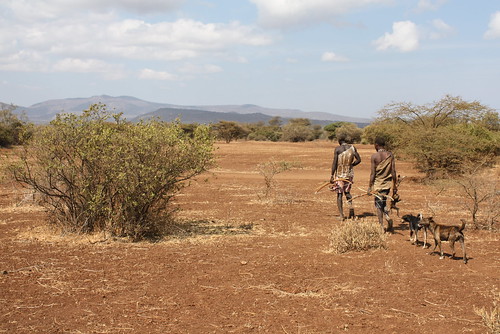
Returning from hunt
Hadza returning from hunt in Tanzania. Credit Andy Lederer.
In William Shakespeare's comedy Twelfth Night, Sir Andrew, who was worried that a joke may have been made at his expense, reasons out loud that maybe his diet had something to do with his lack of intelligence, saying, "But I am a great eater of beef, and I believe that does harm to my wit" (Act I, Scene III). Dialogue like that was how Shakespeare famously poked fun at what he considered "foolery" in his time; it was a common belief of the Elizabethan Age that eating too much meat made you a meat-head. Now, it appears the tables have turned. Vegetarians are getting a taste of similar medicine from comedians of our time.

On November 15th's episode of The Colbert Report, Stephen Colbert interviewed one of the world's foremost paleoanthropologists, Chris Stringer of the Natural History Museum, about his newly published book. During their conversation, Stringer sums up nicely why meat eating may have been the primary force that drove evolution of a brain-gut tradeoff, where a shrinking gut allowed for more energy input into the brain. Here is Stringer's explanation at about minute 18:30 in the episode:
Chris Stringer: "There's a thing called 'expensive tissue hypothesis'. And this says we evolved our large brains by changing our diets. Our ancestors had great big guts because they were vegetarian. They never had enough spare energy because their guts were using 20 percent of their energy; they never had enough spare energy to evolve a large brain. When we started eating meat, a much more concentrated sort of food, it freed up energy and we could start to run a bigger brain."
Stephen Colbert: "That's why vegetarianism seems so stupid to me."

There's little use challenging the evidence that meat, whether eaten raw or cooked, was "brain food" for our ancestors. The fossil record shows a clear correlation between the appearance of hominin meat eating some two million years ago -- as evidenced by stone tools, cutmarked bones, and changes in hominin teeth structure -- and the drastic increase in cranial size that continued until the agricultural revolution. Studies in genetics and in primatology add more support that meat helped enable our ancestors to attain the nutrients required for the development of all our extra neurons. In my last post, for example, I discuss Greg Wray's research on how changes in differences of fat metabolism and neuronal signaling that may have developed as a result of more meat in the diet and probably helped produce our fatter brains.

However, while meat eating may have played a role, the arguments espoused often by writers, "paleo" and Atkins enthusiasts, and meat-lovers of all kinds are often flawed from a nutritional standpoint. The problem is, it just doesn't make a lot of sense that meat eating could have fueled evolution of our larger brains. It's more likely that carbs did.

Neurons run on glucose, not meat

Neurons, which use twice the energy as any other cell type in the body, run almost exclusively on glucose. They don't run on protein and fat.* Moreover, because neurons aren't able to store glucose as glycogen as other cells in the body do, they must receive glucose in constant supply. That's glucose that must be received from the bloodstream 24 hours a day, seven days a week, even while you're asleep. That's glucose for some 86 billion neurons, more than any other primate; by comparison, gorillas contain about 33 billion and chimpanzees only 28 billion neurons. That's glucose in amounts that could not possibly be supplied by any abundance of meat eating.
A human brain is ~3x larger than a chimp's.

To get an expert's standpoint on the topic, I wrote to Peter Ungar, distinguished professor and chair of anthropology at University of Arkansas, who was recently named a fellow of the American Association for the Advancement of Science, what his take was on the role of meat eating versus carbs in human brain evolution. He wrote back,
Even the staunchest meat advocates recognize that protein and fat cannot power the brain – and we lose much of our gluconeogenesis capabilities at weaning. The argument is that meat eating provided the calories needed to power other parts of the body, freeing available carbohydrates to focus on the brain… Even in that case, it’s carbs, not meat that powers the brain (even though meat facilitates the process).
So, let me repeat in my own way: Why was meat important for evolution of larger brains? Although meat does provide some valuable micronutrients and essential fats, there may not be anything incredibly special about meat nutritionally except that it freed up carbohydrate calories for feeding brains that were roughly three times larger than chimps without the use of gluconeogenesis (synthesis of glucose).

According to Wray's evidence from regulatory genes, humans also developed double the glucose transporters in the brain in comparison to chimps. Chimps, on the other hand, have double the glucose transporters in their muscles. That translates to about four times more glucose going to our brains versus our muscles in comparison to chimps. When I asked Ungar what he thought regarding the role of other types foods (e.g. tubers), as well as preparation techniques (e.g. cooking) in also freeing carbs for the brain, he responded,
I believe the hominin lifestyle is more about a broadened niche than meat per se… Lots of people live in lots of places because they can find something to nourish themselves in whatever environment they find themselves in. Western Australian aboriginals did quite well without lots of meat. 
On Wray's research, Ungar also added,
I’m not an expert on fueling the brain, but it makes sense to me that we’re more efficient at getting glucose across (we need it). One could argue that this allows LESS carb intake for a given brain size… Since our brains are roughly 4x the size of Chimps, does that mean we need about the same number of carbs to power them? 
As for evidence of increased starchy food intake – I think the amylase gene copies didn’t take off until relatively recently. Still, evidence of a broadened subsistence base in Homo could certainly have included starchy foods, meat, or anything else they could get their hands on. 
I’m pretty conservative in terms of single-cause, magic bullet explanations without solid evidence from the fossils themselves… Maybe it’s my time chasing broad-diet primates in the rainforest, but I’m hesitant to invoke one food type to explain brain expansion.
Lastly, he wrote,
...the problem now is coming up with ways of testing those hypotheses (meat, cooking, flexibility, fish, etc). In the end, I woudn’t be surprised if there were no magic bullet…  but after all the new and exciting findings coming from isotopes, microwear, etc. not much would surprise me re: the evolution of human diet.
So there you have it -- it's more appropriate to say that a "broadened niche" is what helped fuel evolution of larger brains. Meat provided micronutrients, but more of it more often probably did nothing more than provide more calories so that we could use carbs to fuel our brains. It's certainly possible that other foods like cooking, shore-based foods, and other foods could've played the same role, too.

Cooking Was More Important Than Meat for Brains

In a recent live chat with science writer Ann Gibbons over at ScienceLive, biological anthropologist Richard Wrangham at Harvard and comparative neuroanatomist Suzana Herculano-Houzel had a few interesting things to say on this topic while discussing their recent study published in Proceedings of the National Academy of Sciences. Their study showed that humans would have to spend more than nine hours a day eating raw foods to feed hungry brains (at 2,000 kcal a day) despite whether raw meat was included or not.

In the chat, Wrangham said, as he's argued in his book,
Cooking increases the net energy gained from food from 2 main routes. (1) It increases digestibility (the proportion of food that gets digested and absorbed). For instance cooking is estimated to increase the digestibility of starch in grains by around 30%. It also increases the digestibility of meat, by denaturing the protein. (2) It reduces the physiological costs of digesting our food - because cooking softens food, so it is easier to digest.
A commenter, Fred, questioned the role of meat eating versus cooking in leading to larger brains, to which Wrangham responded,
The meat vs. veg question is totally unresolved! Recent hunter-gatherers ate least meat near the equator, about 35% of diet, rising to ~100% near the poles. But recent hunter-gatherers are not necessarily good models for our ancestors. They have technology (bows and arrows, and poisons) that made hunting easier; but there again, there may have been more animals in the past. Also, the truly great places for hunter-gatherers to live in may have been those where farmers took over in masses, such as the Nile delta, with terrific plant supplies. So the 'paleo-diet' idea that our ancestors were all heavy meat-eaters doesn't acknowledge the likely large variation in % meat / % plant. Anyway, nowadays vegetarians have about the same body mass index as meat-eaters. So meat doesn't seem to do much to affect energy gain. (But raw-dieters, whether vegetarian or meat-eaters, are much thinner on average than cookivores, whether vegetarian or meat-eaters.) Bottom line: meat is less important than cooking when it comes to energy gain.
Is Wrangham suggesting redemption for raw dieting and vegetarianism as a healthy dietary approach in a modern world? Some people might think so. Although, as a nutritionist, I wouldn't recommend them a raw or vegetarian diet. After all, animal protein is valuable for maintaining or building muscle because of its higher quality amino acid profile; specific animal fats (DHA and EPA) are valuable for cardiovascular and brain health; and animal foods generally do provide necessary micronutrients such as zinc that are important for brain health.

Yet, the point here is there was probably "no magic bullet" that led to evolution of human brains and that meat is not necessarily a brain food. Whatever the combination of factors -- cooking, broadened niche, even food sharing -- that led to larger brains, carbs are what really fuel your neurons, and that's not to say you should overconsume carbs either; most of us already do too much of that. So, there's no sense in using evolution of larger brains as an argument for gorging on steak. Too much beef (and too little glucose), as The Bard would've believed, really might do "harm to your wit."

Update: I'm thrilled to share that this blog post was blogged about by Barbara J. King of NPR over at 13.7 -- check it out here. Enjoy!

*12-7 note: Many of you have pointed out my statement "They don't run on protein and fat" is not entirely accurate. Amino acids can be used to synthesize glucose, although this is a metabolically costly process in terms of ATP. As Ungar said, gluconeogenesis is limited in humans. Also, it is possible for the brain to use products of fat catabolism called ketones as fuel (to spare muscle amino acids; in fact, muscle will use ketones first); however, ketones are only use in the brain in periods of prolonged starvation (or on a diet extremely low in calories with little to no carbohydrates) and may lead to adverse health consequences. 

Monday, November 26, 2012

No fat gain while eating well during the Holiday Season: Palatability isolines, the 14-percent advantage, and nature’s special spice

Like most animals, our Paleolithic ancestors had to regularly undergo short periods of low calorie intake. If they were successful at procuring food, those ancestors alternated between periods of mild famine and feast. As a result, nature allowed them to survive and leave offspring. The periods of feast likely involved higher-than-average consumption of animal foods, with the opposite probably being true in periods of mild famine.

Almost anyone who adopted a low carbohydrate diet for a while will tell you that they find foods previously perceived as bland, such as carrots or walnuts, to taste very sweet – meaning, to taste very good. This is a special case of a more general phenomenon. If a nutrient is important for your body, and your body is deficient in it, those foods that contain the nutrient will taste very good.

This rule of thumb applies primarily to foods that contributed to selection pressures in our evolutionary past. Mostly these were foods available in our Paleolithic evolutionary past, although some populations may have developed divergent partial adaptations to more modern foods due to recent yet acute selection pressure. Because of the complexity of the dietary nutrient absorption process, involving many genes, I suspect that the vast majority of adaptations to modern foods are partial adaptations.

Modern engineered foods are designed to bypass reward mechanisms that match nutrient content with deficiency levels. That is not the case with more natural foods, which tend to taste good only to the extent that the nutrients that they carry are needed by our bodies.

Consequently palatability is not fixed for a particular natural food; it does not depend only on the nutrient content of the food. It also depends on the body’s deficiency with respect to the nutrient that the food contains. Below is what you would get if you were to plot a surface that best fit a set of data points relating palatability of a specific food item, nutrient content of that food, and the level of nutrient deficiency, for a group of people. I generated the data through a simple simulation, with added error to make the simulation more realistic.


Based on this best-fitting surface you could then generate a contour graph, shown below. The curves are “contour lines”, a.k.a. isolines. Each isoline refers to palatability values that are constant for a set of nutrient content and nutrient deficiency combinations. Next to the isolines are the corresponding palatability values, which vary from about 10 to 100. As you can see, palatability generally goes up as one moves toward to right-top corner of the graph, which is the area where nutrient content and nutrient deficiency are both high.


What happens when the body is in short-term nutrient deficiency with respect to a nutrient? One thing that happens is an increase in enzymatic activity, often referred to by the more technical term “phosphorylation”. Enzymes are typically proteins that cause an acute and targeted increase in specific metabolic processes. Many diseases are associated with dysfunctional enzyme activity. Short-term nutrient deficiency causes enzymatic activity associated with absorption and retention of the nutrient to go up significantly. In other words, your body holds on to its reserves of the nutrient, and becomes much more responsive to dietary intake of the nutrient.

The result is predictable, but many people seem to be unaware of it; most are actually surprised by it. If the nutrient in question is a macro-nutrient, it will be allocated in such a way that less of it will go into our calorie stores – namely adipocytes (body fat). This applies even to dietary fat itself, as fat is needed throughout the body for functions other than energy storage. I have heard from many people who, by alternating between short-term fasting and feasting, lost body fat while maintaining the same calorie intake as in a previous period when they were steadily gaining body fat without any fasting. Invariably they were very surprised by what happened.

In a diet of mostly natural foods, with minimal intake of industrialized foods, short-term calorie deficiency is usually associated with short-term deficiency of various nutrients. Short-term calorie deficiency, when followed by significant calorie surplus (i.e., eating little and then a lot), is associated with a phenomenon I blogged about before here – the “14-percent advantage” of eating little and then a lot (, ). Underfeeding and then overfeeding leads to a reduction in the caloric value of the meals during overfeeding; a reduction of about 14 percent of the overfed amount.

So, how can you go through the Holiday Season giving others the impression that you eat as much as you want, and do not gain any body fat (maybe even lose some)? Eat very little, or fast, in those days where there will be a feast (Thanksgiving dinner); and then eat to satisfaction during the feast, staying away from industrialized foods as much as possible. Everything will taste extremely delicious, as nature’s “special spice” is hunger. And you may even lose body fat in the process!

But there is a problem. Our bodies are not designed to associate eating very little, or not at all, with pleasure. Yet another thing that we can blame squarely on evolution! Success takes practice and determination, aided by the expectation of delayed gratification.