Showing posts with label sodium. Show all posts

Monday, March 21, 2011

Health markers varying inexplicably? Do some detective work with HCE

John was overweight, out of shape, and experiencing fatigue. What did he do? He removed foods rich in refined carbohydrates and sugars from his diet. He also ditched industrial seed oils and started exercising. He used HealthCorrelator for Excel (HCE) to keep track of several health-related numbers over time (see figure below).


Over the period of time covered in the dataset, health markers steadily improved. For example, John’s HDL cholesterol went from a little under 40 mg/dl to just under 70; see chart below, one of many generated by HCE.


However, John’s blood pressure varied strangely during that time, as you can see on the chart below showing the variation of systolic blood pressure (SBP) against time. What could have been the reason for that? Salt intake is an unlikely culprit, as we’ve seen before.


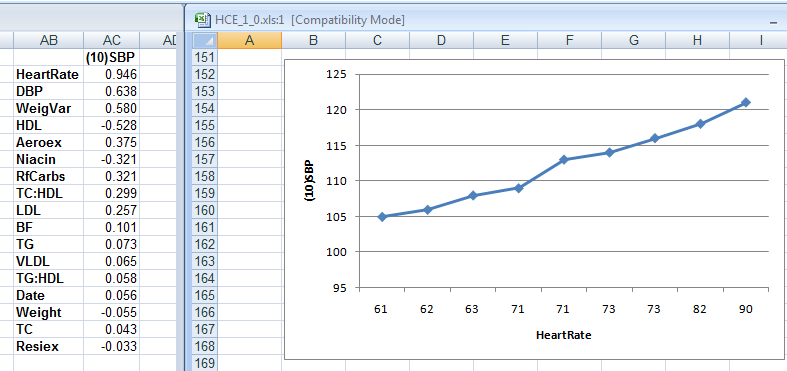
As it turns out, John knew that heart rate could influence blood pressure somewhat, and he also knew that his doctor’s office measured his heart rate regularly. So he got the data from his doctor's office. When he entered heart rate as a column into HCE, the reason for his blood pressure swings became clear, as you can see on the figure below.


On the left part of the figure above are the correlations between SBP and each of the other health-related variables John measured, which HCE lists in order of strength. Heart rate shows up at the top, with a high 0.946 correlation with SBP. On the right part of the figure is the chart of SBP against heart rate.

As you can see, John's heart rate, measured at the doctor's office, varied from 61 to 90 bpm. Given that, John decided to measure his resting heart rate. John’s resting heart rate, measured after waking up using a simple wrist watch, was 61 bpm.

Mystery solved! John’s blood pressure fluctuations were benign, and caused by fluctuations in heart rate.

If John's SBP had been greater than 140, which did not happen, this could be seen as an unusual example of irregular white coat hypertension.

If you are interested, this YouTube video clip discusses in more detail the case above, from HCE’s use perspective. It shows how the heart rate column was added to the dataset in HCE, how the software generated correlations and graphs, and how they were interpreted.

Reference

Kock, N. (2010). HealthCorrelator for Excel 1.0 User Manual. Laredo, Texas: ScriptWarp Systems.

Sunday, May 9, 2010

Sodium: How much is right for you?

Sodium’s association with high blood pressure is well known. However, sodium also plays a large role in keeping you healthy. It’s important to know how to strike the right balance.

Along with potassium, sodium is essential for fluid balance, facilitating the flow of water in and out of cells to bring nutrients in and take wastes away. Sodium also has a role in the regulation of blood pressure and helping muscles and the heart relax. Each sodium ion contains an electrical charge, acting as an electrolyte, which allows transmission of nerve impulses to the brain and throughout the body.

Sodium levels in the body are controlled by the kidneys. If the body doesn’t receive enough sodium daily—a chronic problem for our early ancestors—then the kidneys retain sodium. When the body has a high enough amount, then the excess sodium is excreted in the urine.

At times, sodium levels may fluctuate. If a person has a dysfunctional kidney, then the body may retain too much sodium, which can result in edema, or swelling in the legs and feet because sodium attracts water. In contrast, diarrhea or vomiting may result decreased sodium levels, a condition known as hyponatremia.

How sodium regulates blood pressure is not entirely understood, but there is an established link between high sodium intake and high blood pressure. As expected, there is also a link between sodium reduction and lower blood pressure.

The sodium-hypertension relationship may also have to do with how sodium interplays with other minerals such as potassium and calcium. Potassium, for example, appears to assist the kidneys in shedding excess sodium. Lowering sodium intake also helps to conserve calcium, which may affect blood pressure.

Recommendations for Sodium

The Institute of Medicine is recommending an Adequate Intake of sodium at 1,500 mg per day for adults and children 9-13 as well as 1,000 mg and 1,200 mg per day for children ages 1-3 and 4-8, respectively. These levels are considered appropriate for replacing daily losses via sweat and urine. The need for sodium may be slightly greater if exercise produces excessive sweating or if a person has symptoms of vomiting or diarrhea.

On average, however, most adults in the U.S. consume about 3,200 milligrams or more a day. With these figures, it is easy to understand why high blood pressure affects nearly 75 million Americans. The average intake is well above the Institute of Medicine’s Tolerable Upper Intake Level of 2,300 milligrams per day for adults and 1,500mg, 1,900mg and 2,200 mg for children ages 1-3, 4-8 and 9-13, respectively.

Cutting sodium intake daily tor recommended levels is important and it doesn’t have to be difficult with these three simple strategies:

Sodium Strategy #1: Limit processed or prepared foods high in sodium. Most sodium in the diet doesn’t come from the salt shaker, but from processed and prepared foods. Thus, the best way to lower sodium is to reduce intake of processed foods or replace them with low-sodium alternatives. This includes ready-to-eat packaged foods such as potato chips, fast-food meals such as burritos, and highly salted meals prepared at restaurants.

Sodium Strategy #2: Learn to enjoy food without salt. Taste food before salting it; the food may already be salty enough or it may be enjoyed without salt. In fact, salty is an acquired taste. The body and taste buds can easily adjust to less salt. Studies have shown that as people reduce salt intake and stick to a relatively lower intake of sodium, they will naturally begin to prefer foods with less salt. When eating at home, try not having the salt shaker on the table and, if eating out, simply move salt shakers to another table. When preparing food, try using less salt and seasoning food with spices or salt-substitutes instead. Keep an eye on store-bought spice blends, though, as many may contain high amounts of salt.

Sodium Strategy #3: Balance sodium with potassium-rich fruits and vegetables. A clear association exists between higher potassium intake from fruits and vegetables and lower blood pressure regardless of sodium intake. Potassium helps the kidneys in promoting sodium excretion, reduces urinary calcium and magnesium (which influence blood pressure), supports smooth vascular muscle health, and helps with regulation of blood pressure.

Less Sodium in a DASH

Most people who are interested in maintaining healthy blood pressure levels would do best to follow a DASH (Dietary Approaches to Stop Hypertension)eating plan. In the well-known DASH-sodium study, which was conducted by the National Heart, Lung and Blood Institute, people following the diet lowered blood pressure in just 14 days even without reducing salt intake.

The DASH eating plan includes consuming a diet rich in low-fat, low-sodium dairy products, fish, chicken and lean meats as well as large amount of whole grains, fruits and vegetables.

When a person is concerned about blood pressure, the best advice nutritionists can give is to begin following a DASH eating plan combined with regular exercise and weight management. In fact, according to a recent study in Hypertension, this plan helped people reduce blood pressure, lose weight, improve mental function, and improve cardiovascular health.

Taking the Pressure Off of Sodium

It’s extremely easy to place all of the blame for society’s high blood pressure woes and medical costs on sodium, but the mineral’s role in the body should not be ignored. Sodium is essential for good health and too little could lead to other health issues, including deficiencies in iodine, which is mainly provided in the North American diet from iodized salt.

While lowering sodium consumption can lead to a natural preference for foods with less salt, it’s important not to cut salt out completely. Because the body requires some sodium to function properly, avoiding salt entirely might backfire, and cause cravings for high-sodium foods. As with almost all vitamins and minerals, the key to healthy sodium intake is always balance with other nutrients. A DASH eating plan and strategies for maintaining a healthy intake (such as those given above) can help you achieve this balance of nutrients for healthy blood pressure levels and optimal health.

Reference

Dyuff RL, American Dietitic Association. American Dietetic Association Complete Food and Nutrition Guide, 3rd edition. 2006. Wiley.

Wednesday, January 27, 2010

The low modern potassium-to-sodium ratio: Big problem or much ado about nothing?

It has been argued that the diets of our Paleolithic ancestors had on average a much higher potassium-to-sodium ratio than modern diets (see, e.g., Cordain, 2002).

This much lower modern ratio is believed by some to be the cause of a number of health problems, including: high blood pressure, stroke, heart disease, memory decline, osteoporosis, asthma, ulcers, stomach cancer, kidney stones, and cataracts.

But, is this really the case?

The potassium-to-sodium ratio in ancient and modern times

According to some estimates, our Paleolithic ancestors’ daily consumption was on average about 11,000 mg of potassium and about 700 mg of sodium (salt). That yields a potassium-to-sodium ratio of about 16. Today’s ratio in industrialized countries is estimated to be around 0.6.

Just for the sake of illustration, let us compare a healthy Paleolithic diet food, walnuts, with a modern industrialized food that many believe to be quite healthy, whole-wheat bread. The table below (click on it to enlarge) compares these two foods in terms of protein, carbohydrate, fat, vitamin, and mineral content.


Walnuts have a potassium-to-sodium ratio of about 205. The whole-wheat bread’s ratio is about 0.5; much lower, and close to the overall ratio estimated for industrialized countries mentioned above.

At the same time, walnuts provide a better nutritional value than whole-wheat bread, including a good amount of omega-3 fatty acids (2.5 g; of α-linolenic acid, or ALA). However, walnuts have a fairly high omega-6 fat content.

Also, many diabetics experience elevated blood glucose levels in response to whole-wheat bread, in spite of its glycemic index being supposedly lower than that of white bread. Walnuts do not seem to cause this type of problem, even though several people are allergic to walnuts (and other tree nuts).

Health effects of the potassium-to-sodium ratio

So, the potassium-to-sodium ratio appears to have been much higher among our Paleolithic ancestors than today. It is important to stress that, even though this is a possibility, we do not know this for sure. Animals go to great lengths to find salt licks, and then consume plenty of sodium in them. Our ancestors could have done that too. Also, we know that sodium deficiency can be deadly to both animals and humans.

As for the many negative health effects of a low potassium-to-sodium ratio in modern humans, we have reasons to be somewhat skeptical. One has to wonder if the studies that are out there do not conflate the effects of this ratio with those of other factors, such as smoking, heavy alcohol consumption, or consumption of industrialized high carb foods (e.g., cereals, pasta, refined sugars).

Another possible confounding factor is potassium deficiency, not the potassium-to-sodium ratio. Potassium deficiency, like other deficiencies of essential minerals, including sodium deficiency, is associated with serious health problems.

If potassium is deficient in one’s diet, it is also likely that the potassium-to-sodium ratio will be low, unless the diet is also equally deficient in sodium.

Let us take a look at a study by Ikeda et al. (1986), which included data from 49 regions in Japan, a country known for high consumption of sodium.

This study found a significant association between the potassium-to-sodium ratio and overall mortality and heart disease, but only among men, and not among women.

One wonders, based on this, whether another uncontrolled factor, or factors, might have biased the results. Examples are smoking and heavy alcohol consumption, which could have been higher among men than women. Another is chronic stress, which could also have been higher among men than women.

The researchers report that they found no association between the potassium-to-sodium ratio and mortality due to diabetes, liver disease, or tuberculosis. This ameliorates the problem somewhat, but does not rule out the biasing effect of other factors.

It would have been better if the researchers had controlled for the combined effect of covariates (such as smoking, alcohol consumption etc.) in their analysis; which they did not.

Moreover, the study found no association between the potassium-to-sodium ratio and blood pressure. This is a red flag, because many of the diseases said to be caused by a low potassium-to-sodium ratio are assumed to be mediated by or at least associated with high blood pressure.

Regarding the possible confounding effect of industrialized high carb foods consumption, it seems that many of these foods have a low potassium-to-sodium ratio, as the example of whole-wheat bread above shows. Thus, some of the health problems assigned to the low potassium-to-sodium ratio may have actually been caused by heavy consumption of industrialized high carb foods.

It is also possible that the problem is with the combination of a low potassium-to-sodium ratio and industrialized high carb foods consumption.

At the time the study was conducted, Japan was somewhat westernized, which is why industrialized high carb foods consumption might have been a factor. The US strongly influenced the Japanese after World War II, as it helped rebuild Japan’s economy.

In conclusion, the jury is still out there regarding whether the low modern potassium-to-sodium ratio is a big problem or much ado about nothing.

References:

Cordain, L. (2002). The Paleo Diet: Lose weight and get healthy by eating the food you were designed to eat. New York, NY: Wiley.

Ikeda, M., Kasahara, M., Koizumi, A., and Watanabe, T. (1986). Correlation of cerebrovascular disease standardized mortality ratios with dietary sodium and the sodium/potassium ratio among the Japanese population. Preventive Medicine, 15(1), 46-59.